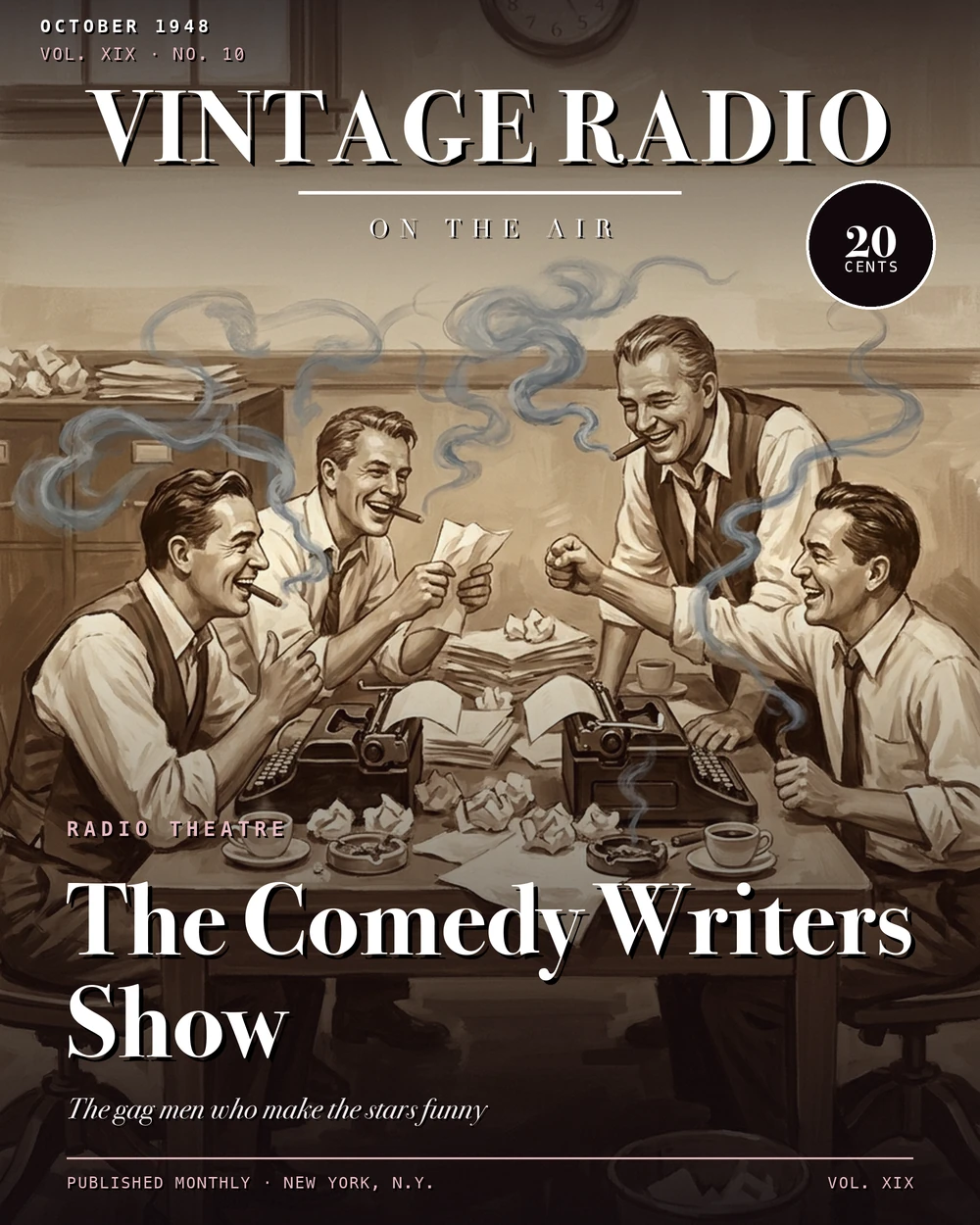
The Comedy Writers Show
A Strange Little Idea That Ran One Summer
Most radio comedies in 1948 kept the machinery hidden. The writers cranked out scripts in back offices, the stars delivered the jokes, and the audience laughed without ever thinking about how the sausage got made. The Comedy Writers Show flipped that around. Its premise put the spotlight on the writing process itself — or at least a playful, celebrity-driven version of it — by inviting guest personalities to suggest comedy scripts tied to the era's biggest radio comedy programs. It was a meta-comedic conceit that felt genuinely unusual for its time.
The show premiered on June 13, 1948, and its last known broadcast aired on July 18, 1948, a run of roughly five weeks. Four episodes survive in the catalog. That's a short life, but the snapshot those four episodes offer is a specific one: a summer experiment, the kind networks tried out when their major programs went on seasonal hiatus, built around a format that treated the business of writing radio comedy as entertainment in its own right.
The Guests and What They Suggested
The four surviving episodes each follow the same structure: a guest personality suggests a comedy script tied to a specific existing program or comedian. Loretta Young stepped in to suggest an Allen's Alley show — a nod to the signature segment of Fred Allen's NBC program, which had been ranked the number-one rated show in the country as recently as February 1948. Susan Hayward's episode revolved around a suggested Abbott and Costello script, pointing at a comedy duo whose ABC program was then in the middle of a nine-year radio run. Maureen O'Hara suggested a Bob Hope script, referencing one of the longest-running comedy programs in radio history, a show whose writing staff was itself a well-known institution. That last detail gives the format an extra layer — having a movie star propose material for a show defined by its professional writers was, implicitly, a joke about who really runs the room.
The fourth guest was Robert Ripley, the Believe It or Not! cartoonist and broadcaster, who suggested a variety-situation comedy. Ripley stood out from the otherwise film-star lineup. By mid-1948 his radio career was winding down — his NBC series Pages From Robert Ripley's Scrapbook would end in September of that year — and he was already moving toward television. His presence gave the show a slightly different texture than the Hollywood-celebrity formula the other three episodes followed.
What the Guest List Tells You
Young, Hayward, and O'Hara were all active in Hollywood at the time of their appearances, and all three had radio experience. Hayward had appeared on Lux Radio Theatre, Screen Guild Theater, and Suspense. O'Hara had a Screen Guild Theater broadcast earlier in 1948 and a Lux Radio Theatre appearance later that same year. Young was a familiar voice to radio audiences, though her more famous television run — The Loretta Young Show on NBC — was still five years away.
The comedy programs they referenced were all at recognizable peaks or pivotal moments in 1948. Allen's Alley ended its network run that same year, making the Young episode a timely reference. Abbott and Costello were mid-stride in their ABC run. Hope's program had been a fixture since 1938. The targets were chosen carefully — these were the programs the audience would recognize instantly, which was the point. The joke only works if everyone in the room already knows what Allen's Alley sounds like.
What Survives
Four episodes is a thin record, but it's enough to understand what The Comedy Writers Show was trying to do. It was a summer comedy that turned radio's own conventions into its subject matter — leaning on audience familiarity with the era's biggest programs and treating the concept of the "suggested script" as a comic frame. Whether the episodes themselves delivered on the premise is for the listener to decide. The format was original enough that the show's brief run remains a distinct curiosity from a summer when networks had room to try things out.